
Legal Drafting & Court Craft
From understanding the law to drafting for practice. Learn to structure civil pleadings, draft arbitration applications, prepare commercial contracts and develop the written skills used in everyday court practice.
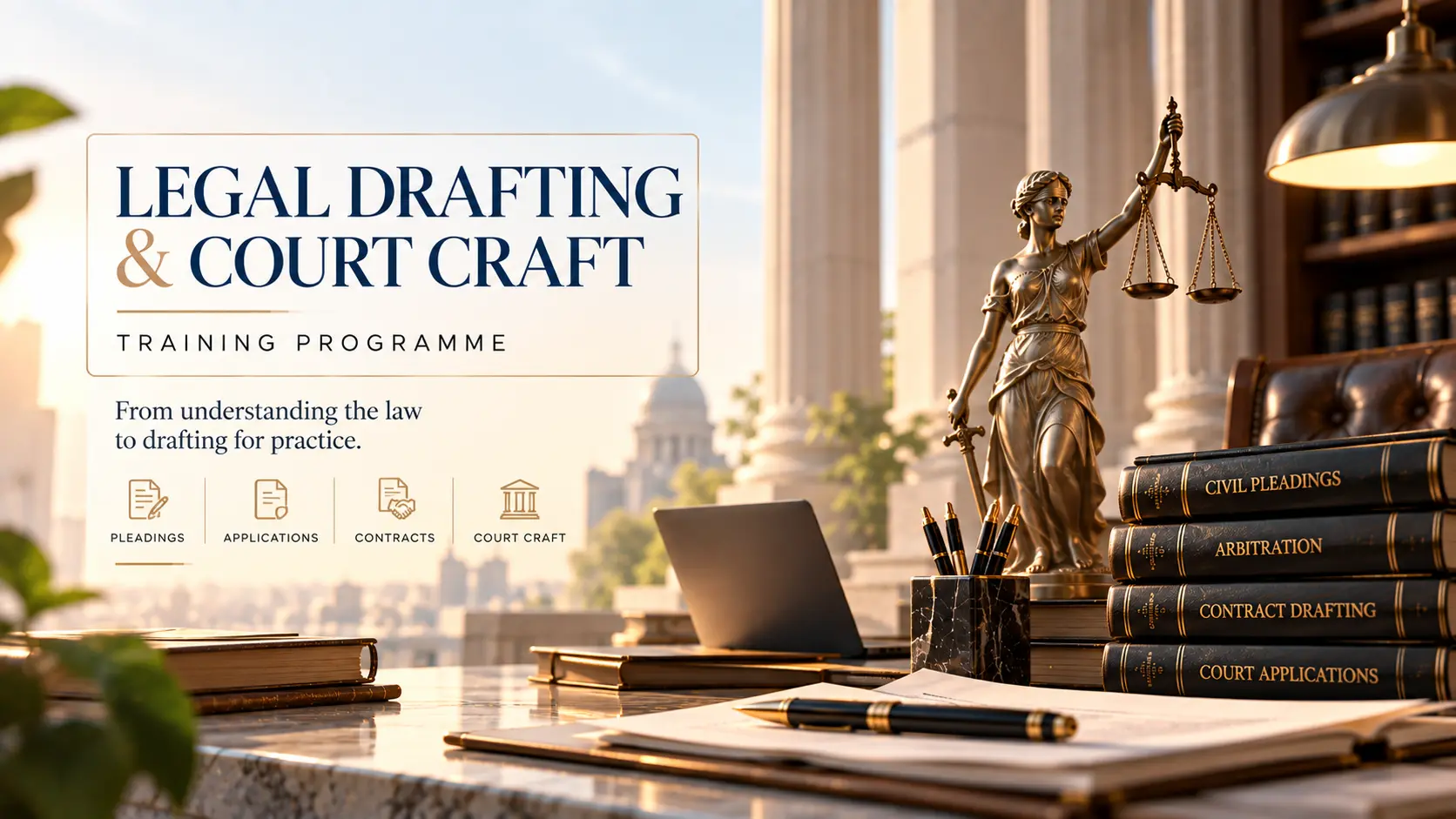
Draft with clarity. Prepare for real legal practice.
A structured programme covering civil pleadings, interim applications, arbitration, contracts, written submissions, legal notices and practical court preparation.
Build the drafting skills that support everyday legal practice.
Knowing the law is one part of legal practice. Translating a client’s facts into a clear pleading, an effective contractual clause or a well-structured court submission requires a different set of skills.
Resolvify’s Legal Drafting & Court Craft programme introduces law students and newly enrolled advocates to drafting work encountered in everyday practice.
Across 12 live sessions, participants explore civil pleadings, arbitration applications, commercial contracts, legal notices and court submissions, supported by case review and doubt-clearing sessions.
Course Curriculum
12 live sessions · 6 weekends · 1 hour per session. The programme progresses from pleadings and applications to contracts, court preparation and practical review.
Plaint, Written Statement & Counter-Claim
- Essential components of a plaint under Order VII CPC, including material facts, cause of action, jurisdiction and reliefs.
- Pleading limitation, court fees and valuation, and drafting clear prayer clauses.
- Structuring a written statement with preliminary objections, paragraph-wise replies and additional pleas.
- Specific denials, counter-claims and set-off, along with common drafting defects that can lead to rejection of a plaint.
Interlocutory Applications under the CPC
- Drafting applications for temporary injunctions under Order XXXIX Rules 1 and 2 CPC.
- Understanding prima facie case, balance of convenience and irreparable injury.
- Presenting urgency when seeking ex parte or ad-interim relief.
- Drafting applications for condonation of delay, supporting affidavits and verification clauses.
Arbitration Applications under Sections 9, 16 & 17
- Drafting petitions under Section 9 for interim measures of protection from courts.
- Presenting the factual background, urgency and relief sought in an interim application.
- Framing jurisdictional objections under Section 16, including challenges concerning the arbitration agreement.
- Drafting applications under Section 17 for interim measures from the arbitral tribunal and understanding their enforcement.
Civil Appeals & Setting Aside of Arbitral Awards
- Structuring a memorandum of appeal against a decree under Order XLI CPC.
- Identifying appealable orders under Order XLIII CPC and framing precise grounds of appeal.
- Drafting petitions under Section 34 of the Arbitration and Conciliation Act to set aside arbitral awards.
- Understanding limitation, the scope of challenge, and the distinction between a Section 34 petition and a Section 37 appeal.
Review, Revision & Execution
- Drafting review petitions under Section 114 and Order XLVII CPC.
- Understanding the scope of revision under Section 115 CPC and its distinction from an appeal.
- Preparing execution petitions under Order XXI CPC, including the relief and mode of execution sought.
- Addressing objections to execution and drafting applications for stay of execution.
Doubt-Clearing & Case Review I
- Review anonymised case files and drafts covering Sessions 1–5.
- Discuss the structure and content of civil pleadings, interim applications and arbitration applications.
- Identify common errors in drafting appeals, review petitions and execution petitions.
- Resolve participant questions and receive feedback on legal accuracy, clarity and completeness.
Contract Formation, Structure & Recitals
- Understand the essentials of a valid contract, including offer, acceptance, consideration, capacity and consent.
- Explore how contracts are formed through the communication of offer and acceptance.
- Identify the building blocks of a contract: recitals, definitions, representations, warranties and covenants.
- Draft accurate party descriptions and clear recitals, with attention to differences between commercial and employment contracts.
Commercial Clauses, Contract Types & Dispute Resolution
- Draft force majeure, indemnity and limitation of liability clauses, and understand how they interact.
- Structure confidentiality and termination provisions, including survival clauses and cure periods.
- Frame dispute resolution clauses covering litigation or arbitration, governing law, jurisdiction and escalation procedures.
- Examine drafting considerations for MoUs, letters of intent, NDAs, service agreements and employment agreements.
Court Craft & Written Submissions
- Organise written submissions around the issues requiring determination.
- Present facts, legal propositions and authorities clearly, with disciplined citation.
- Prepare a synopsis and list of dates for petitions and court proceedings.
- Develop concise court notes to support structured oral arguments.
Drafting Legal Notices
- Structure a legal notice with relevant facts, the grievance, the demand and a timeline for compliance.
- Draft notices for recovery of money, specific performance and recovery of possession.
- Prepare notices invoking arbitration under Section 21 of the Arbitration and Conciliation Act.
- Examine the contents and procedural requirements of demand notices in cheque-dishonour matters under Section 138 of the NI Act.
Section 138 NI Act Complaints, Magistrate Applications & Bail
- Structure a cheque-dishonour complaint with the relevant transaction details, documents and cause of action.
- Prepare verification and supporting document lists.
- Explore accompanying applications, including applications for issuance of process and compounding.
- Draft regular and anticipatory bail applications, distinguishing factual background from legal grounds.
Doubt-Clearing & Case Review II
- Review anonymised contracts, notices, complaints and applications covered in Sessions 7–11.
- Discuss common drafting errors, ambiguous clauses and missing particulars.
- Receive feedback on drafting precision, document structure and practical usability.
- Consolidate learning and resolve outstanding questions across the programme.
What You’ll Gain
Practical exposure across key areas of legal drafting and court preparation.
A Structured Approach to Drafting
Learn how to organise facts, identify relevant issues, frame grounds and express the relief or contractual outcome sought.
Exposure to Common Legal Documents
Explore pleadings, arbitration applications, commercial agreements, written submissions, notices and complaints within one programme.
Learning Through Anonymised Case Files
See how drafting principles apply to documents drawn from practice during two dedicated case-review sessions.
Opportunities to Ask Questions
Revisit difficult concepts, discuss drafting choices and raise questions during the doubt-clearing sessions.
Feedback on Drafting Exercises
Receive brief verbal feedback on legal accuracy, clarity, structure, completeness and practical usability.
A Weekend Schedule
Attend one-hour sessions on Saturdays and Sundays across six consecutive weekends.
Who Should Attend?
The programme is designed for learners and early-career professionals building practical legal drafting and court-preparation skills.
Law Students
Build familiarity with the documents and drafting tasks encountered during internships and early legal practice.
Newly Enrolled Advocates
Develop a more structured approach to pleadings, applications, contracts and court preparation.
Early-Career Legal Professionals
Strengthen practical drafting skills across contracts, notices, submissions and litigation documents.
Frequently Asked Questions
Click a question to view the answer.
Who is this course for?
What is the schedule?
Will there be opportunities to ask questions?
How will drafting exercises be reviewed?
What areas of drafting are covered?
What is the course fee?
How do I register?
Build your foundation in legal drafting.
Explore the documents, drafting decisions and written skills that support everyday legal practice, from pleadings and contracts to court submissions and notices.