
WHEN ARBITRATION MEETS INSOLVENCY AT THE BORDER: INDIA’S MISSING FRAMEWORK AND WHY IT MATTERS
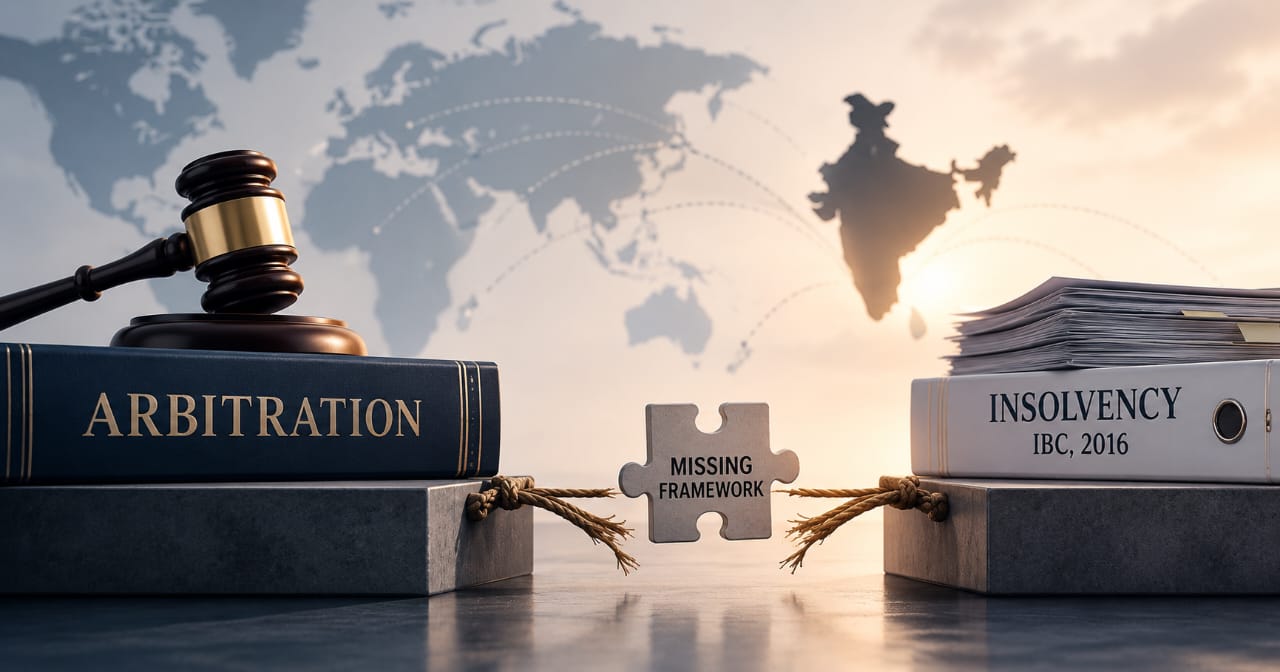
Consider a Singaporean creditor holding a USD 12 million arbitral award against an Indian corporate debtor. Before recognition proceedings can be completed before a High Court, an insolvency application is admitted before the National Company Law Tribunal (NCLT), and a moratorium descends under Section 14 of the Insolvency and Bankruptcy Code, 2016 (IBC). The creditor is frozen mid-step unable to enforce without recognition, and unable to seek recognition because the moratorium bars the very proceedings that would confer it. This is not a hypothetical. It is a recurring practical problem at the intersection of India’s two most commercially significant procedural regimes: international arbitration and insolvency law.
Private international law scholars have long described this interface as a conflict of “near polar extremes.” 2 Arbitration is bilateral and consensual; insolvency is collective and compulsory. When an Indian company enters the Corporate Insolvency Resolution Process (CIRP) while party to a foreign-seated arbitration, these systems collide and without adequate legislative infrastructure, the collision produces commercially damaging results.
I. THE MORATORIUM’S DOUBLE FAILURE
Section 14 of the IBC is the cornerstone of CIRP. Upon admission of an insolvency application, the NCLT imposes an automatic stay on all suits and proceedings against the corporate debtor. The Supreme Court in Alchemist Asset Reconstruction Company Ltd. v. Hotel Gaudavan Pvt. Ltd.3 held that Section 14 operates as an absolute bar on the continuation of arbitral proceedings once CIRP commences. This blanket rule has been widely criticised. Most developed insolvency systems distinguish between “core” disputes those concerning administration of the estate and “non-core” disputes, such as the quantum of a contractual debt, which do not disrupt the collective process. As Hristova and Alvarado Garzon observe, non-core issues involving contractual claim determination are generally considered arbitrable in principle.4 The Alchemist rule collapses this distinction entirely, extinguishing the party’s contractual bargain without principled justification.
The moratorium’s second failure is jurisdictional. Under Section 1(2), the IBC applies only within India. Section 234 empowers the Central Government to enter bilateral agreements with foreign
1 Author, Intern at Resolvify May-2025, LL.M. IBL, Nalsar University of law, Hyderabad and IICA.
2 Velislava Hristova & Andres Eduardo Alvarado Garzon, International Arbitration and Cross-Border Insolvency —
Friends or Foes?, 12 J. Int’l Dispute Settlement 693, 693 (2021), https://doi.org/10.1093/jnlids/idab013
3 Alchemist Asset Reconstruction Co. Ltd. v. Hotel Gaudavan Pvt. Ltd., (2018) 16 SCC 94 (India).
4 Hristova & Alvarado Garzon, supra note 1, at 695.
states to extend the Code’s reach but no such agreement exists with any jurisdiction.5 An arbitral tribunal seated in London or Singapore is under no obligation to recognise or give effect to an Indian moratorium. The consequence is stark: the corporate debtor is simultaneously overprotected at home and entirely unprotected abroad, while creditors across different countries operate under wholly different rules.
II. THE FOREIGN AWARD TRAP
The position of a foreign creditor holding an arbitral award against an Indian company in CIRP illustrates the full depth of this problem. Under Indian law, a foreign award is not self-executing. The Supreme Court in Government of India v. Vedanta Ltd.6 clarified that a foreign award is not
a decree by itself its legal force within India depends entirely on recognition proceedings under Part II of the Arbitration and Conciliation Act, 1996. Only once a High Court is satisfied under Section 48 does Section 49 deem the award a decree. The Bombay High Court in Noy Vallesina Engg. SpA v. Jindal Drugs Ltd.7 confirmed that an unrecognised foreign award “cannot be relied on for any purpose in India.”
Now introduce the moratorium. If CIRP commences before the recognition process is complete a realistic scenario given the pace of Indian commercial litigation, Section 14 bars even the recognition proceeding itself. The creditor is caught in a procedural loop like enforcement requires recognition, recognition is barred, and once CIRP concludes and the clean slate principle operates, the award may be rendered worthless.
Indian tribunals have tried creative workarounds. The NCLT Kolkata bench in Yes Bank Ltd. v. Sarga Hotels (P) Ltd. 8 admitted an unrecognised foreign award as a contingent claim, holding the amount in escrow pending judicial recognition. This preserves the creditor’s position, but introduces uncertainty about valuation and priority. The NCLT Mumbai’s approach in Agrocorp International Pvt. Ltd. v. National Steel and Agro Industries Limited9 permitting CIRP initiation by treating an unrecognised foreign award as a foreign decree under Section 44-A of the Civil Procedure Code has been rightly criticised for conflating two distinct statutory regimes. The Calcutta High Court in Jaldhi Overseas Pte. Ltd. v. Steer Overseas Pvt. Ltd.10 correctly held that an unrecognised foreign award cannot found a Section 9 application. These divergent outcomes are not the product of judicial inconsistency alone they reflect structural impossibility. Courts are being asked to improvise solutions to a problem that requires legislative architecture.
5 Ayush Agarwala & Aviva Jogani, Foreign Seated Arbitration and Indian Insolvency: A Confluence of Challenges,
Bombay Law Chambers (2025), https://bombaylawchambers.com/foreign-seated-arbitration-and-indian-insolvencya-confluence-of-challenges/
6 Government of India v. Vedanta Ltd., Civil Appeal No. 3185 of 2020 (India).
7 Noy Vallesina Engg. SpA v. Jindal Drugs Ltd., (2021) 1 SCC 382 (India).
8 Yes Bank Ltd. v. Sarga Hotels (P) Ltd., 2023 SCC OnLine NCLT 1051 (NCLT Kolkata) (India).
9 Agrocorp International Pvt. (PTE) Ltd. v. National Steel and Agro Industries Ltd., CP (IB) No. 798/MB/C IV/2019
(NCLT Mumbai) (India).
10 Jaldhi Overseas Pte. Ltd. v. Steer Overseas Pvt. Ltd., P No. L8/CTB/2019 (NCLT Cuttack) (India).
III. THE MISSING MODEL LAW
The root cause is well-known and insufficiently remedied: India has not adopted the UNCITRAL Model Law on Cross-Border Insolvency, 1997 (MLCBI). As of 2024, the Model Law has been adopted by 62 states across 65 jurisdictions.11 It provides structured mechanisms for recognising foreign insolvency proceedings, establishes the Centre of Main Interests (COMI) concept to identify the primary jurisdiction, and critically creates the legal infrastructure within which arbitral and insolvency proceedings can be consciously coordinated rather than left to collide. India’s IBC addresses cross-border insolvency through only two provisions. Section 234 permits bilateral agreements with foreign states, Section 235 allows Indian courts to issue letters of request to foreign courts. Neither has been operationalised. No bilateral agreement has been concluded with any major trading partner. The Ministry of Corporate Affairs Insolvency Law Committee recommended adoption of the MLCBI in October 2018,12 and a draft Cross-Border Insolvency Bill was circulated in 2020. Neither has been enacted.
The practical consequence is significant. Raghav and Mathur observe that the New York Convention’s enforcement framework is structurally superior to the existing cross-border insolvency landscape, precisely because it operates across approximately 170 jurisdictions on a predictable, pro-enforcement basis.13 But arbitration can serve cross-border insolvency well only if the insolvency framework is sophisticated enough to engage with foreign arbitral proceedings on principled terms. Gropper has argued persuasively that international arbitration can serve as a substitute vehicle for resolving cross-border insolvency disputes in the absence of a functioning multilateral insolvency framework because the New York Convention provides the enforcement infrastructure that cross-border insolvency law still lacks. For India, the New York Convention may presently be the most reliable thread connecting an Indian insolvency proceeding to the broader international commercial order.
IV. WHAT OTHER JURISDICTIONS HAVE FIGURED OUT
The US, UK, and Singapore each demonstrate that the arbitration-insolvency tension is manageable, but only with adequate legislative infrastructure. The United States adopted the MLCBI through Chapter 15 of the Bankruptcy Code in 2005 and developed the “inherent conflict” test: arbitration clauses are enforced in bankruptcy unless they would “seriously jeopardise the objectives of the Bankruptcy Code.” 14 This preserves the right to arbitrate non-core disputes while protecting the collective framework where it matters. The United Kingdom enacted the MLCBI
11 UNCITRAL, Status of the Model Law on Cross-Border Insolvency (1997),
https://uncitral.un.org/en/texts/insolvency/modellaw/cross-border_insolvency/status
12 Ministry of Corporate Affairs, Report of the Insolvency Law Committee on Cross-Border Insolvency (Oct. 2018),
https://www.mca.gov.in/Ministry/pdf/CrossBorderInsolvencyReport_22102018.pdf
13 Tejas Vijay Raghav & Arnav Sanjay Mathur, International Arbitration: The Remedy to Cross-Border Insolvency’s
Enforcement Woes in a Post-Model Law World, 7 Ind. Arb. L. Rev. 77, 87 (2025),
https://www.indianarbitrationlawreview.com/publications
14 Allan L. Gropper, The Arbitration of Cross-Border Insolvencies, 86 Am. Bankr. L.J. 201, 202 (2012),
https://www.researchgate.net/publication/298833780_The_Arbitration_of_Cross-Border_Insolvencies
Through the Cross-Border Insolvency Regulations 2006. In Riverrock Securities Ltd v. International Bank of St Petersburg (JSC), 15 the English High Court permitted arbitration ofinsolvency-related claims that did not prejudice third-party creditors reflecting a consistent posture that arbitration and insolvency can coexist where individual advantage is not being gained at collective expense.
Singapore presents the most instructive model for India. Sharing a common law heritage and its role as Asia’s premier arbitration hub, Singapore adopted the MLCBI through the Companies (Amendment) Act 2017 and developed the “case management stay” courts pause arbitral proceedings temporarily during insolvency and revive them when appropriate, rather thanpermanently barring them. The Court of Appeal in Larsen Oil and Gas Pte Ltd v. Petroprod Ltd.16 confirmed that while arbitrators cannot make winding-up orders, they can determine contractual claims arising in an insolvency context. The lesson across all three jurisdictions is the same: the MLCBI is not merely a technical instrument it is the legal infrastructure that makes principled, case-by-case coordination between arbitration and insolvency possible. Without it, courts are forced into blunt and inconsistent improvisation.
V. THREE REFORMS INDIA NEEDS
First, India must enact the Cross-Border Insolvency Bill and adopt the MLCBI. This is not a radical step it is base alignment with global standards accepted by 65 jurisdictions. The MLCBI’s recognition mechanism and COMI framework would immediately address the structural void that currently leaves foreign arbitral proceedings outside the moratorium’s reach and Indian insolvency proceedings without a principled basis for cooperating with foreign courts. Second, Section 14 of the IBC must be amended to distinguish between core and non-core arbitral proceedings. The blanket bar is both over-inclusive and under-theorised. Parliament should provide that arbitral proceedings are suspended not terminated during the moratorium, and that proceedings involving the quantum of a specific contractual debt may resume once the moratorium lifts or be channelled into the CIRP claims process without losing the benefit of the tribunal’s findings.
Third, Sections 234 and 235 must be operationalised through bilateral cross-border insolvency agreements with India’s principal trading partners the UK, Singapore, the UAE, and the US. These agreements would extend the reach of Section 14 to foreign-seated proceedings, address the asymmetry between domestic and international protection, and send a clear signal to foreign creditors that Indian insolvency proceedings honour the obligations Indian companies have undertaken abroad.
15 Riverrock Securities Ltd v. International Bank of St Petersburg (JSC), [2020] EWHC 2483 (Comm) (U.K.),
https://www.bailii.org/ew/cases/EWHC/Comm/2020/2483.html
16 Larsen Oil and Gas Pte Ltd v. Petroprod Ltd., [2011] SGCA 21 (Sing.),
https://www.elitigation.sg/gd/s/2011_SGCA_21
CONCLUSION
India’s arbitration and insolvency frameworks are individually impressive. The Arbitration and Conciliation Act, as amended in 2015 and 2019, reflects genuine legislative commitment to making India arbitration friendly. The IBC modernised Indian insolvency law from a fragmented colonial inheritance into a coherent, time-bound process. The problem is that neither statute was designed with the cross-border dimension in mind, and their interaction has been abandoned to judicial improvisation.
Improvisation cannot substitute for legislation. Until the MLCBI is adopted, Section 14 is reformed, and bilateral agreements are operationalised, foreign creditors holding awards against Indian companies will continue to find themselves caught mid-step and India will continue to project a territorialism that its own commercial ambitions have long since outgrown.
Written By: Tejaswini VJ